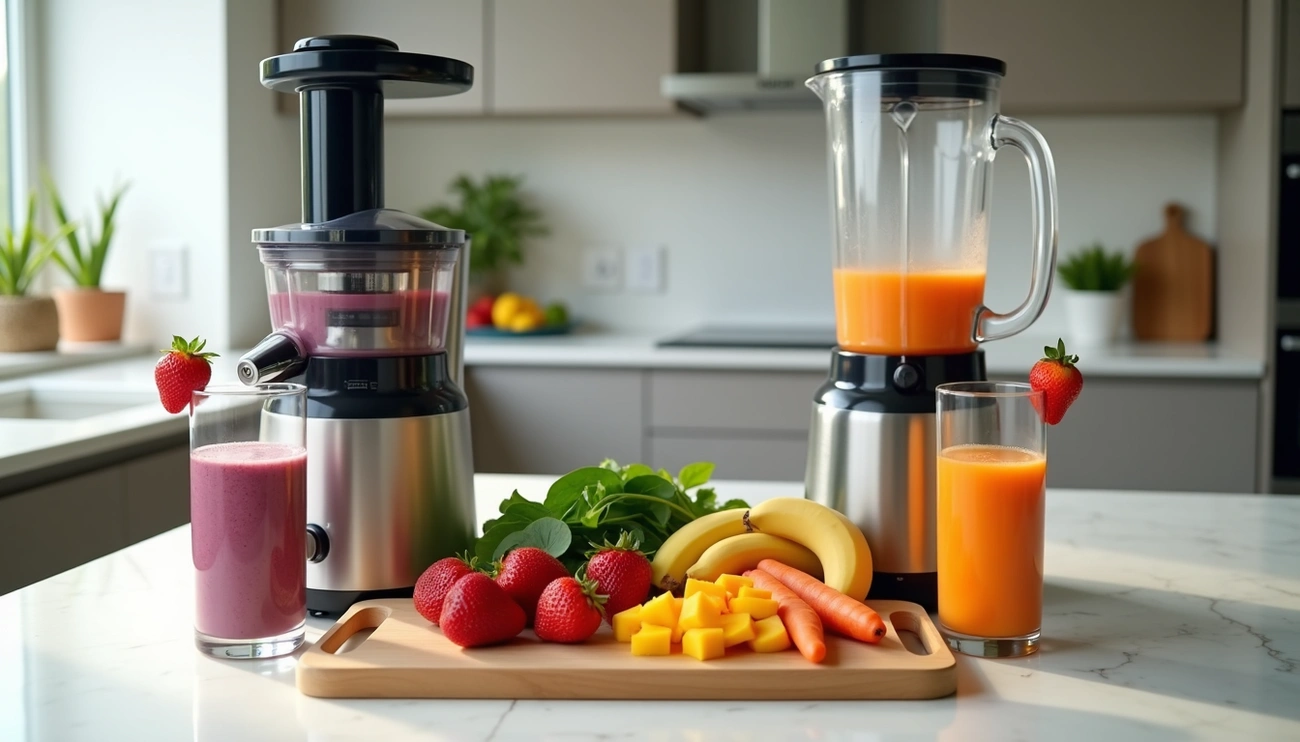
Yes, some juicers can make smoothies, but traditional centrifugal juicers cannot. High-end slow masticating juicers, such as Kuvings or Hurom, can produce smoothies when fitted with a large-hole smoothie strainer that retains pulp and fiber. This setup creates a thick, creamy texture instead of separated juice.
Juicer vs Blender: What’s the Real Difference?
The fundamental difference between juicers and blenders lies in their processing methods. Juicers extract juice by separating the liquid from the fiber, primarily giving you nutrient-rich juice without the pulp. Blenders, conversely, process the entire ingredient, breaking down everything into a smooth mixture that retains all fiber and nutrients.
How each appliance processes ingredients
Juicers work through two main mechanisms. Centrifugal juicers use spinning blades that shred ingredients against a mesh filter, forcing juice through tiny holes while collecting pulp separately. Cold press juicers (also called masticating juicers) crush and press ingredients through a screen, extracting juice more thoroughly.
Blenders operate quite differently. They use rapidly spinning blades to pulverize entire ingredients into a uniform mixture. Nothing gets separated—what goes in stays in, just in a different form. This fundamental difference explains why the texture and nutritional profile of juices versus smoothies varies so dramatically.
Which one is better for smoothies?
For traditional smoothies, blenders are naturally superior. The defining characteristic of a smoothie is its thick, creamy texture from retained fiber and pulp—exactly what blenders preserve. Blenders also handle frozen ingredients, ice, yogurt, and protein powders effortlessly, creating that signature smoothie consistency.
Nevertheless, certain juicers can approximate smoothies, particularly cold press models with smoothie-making attachments. These specialized attachments alter how the machine processes ingredients, allowing some fiber to remain in the final product.
Can a juicer replace a blender?
A juicer cannot completely replace a blender for all tasks, mainly because they serve different purposes. Although certain advanced juicers with smoothie attachments can create smoothie-like beverages, they generally cannot:
- Process thick ingredients like nut butters or avocados
- Handle ice or frozen fruits as efficiently
- Create the same consistency as blender-made smoothies
Furthermore, typical juicers remove fiber—a key smoothie component. Yet, some creative approaches exist. For instance, you can reincorporate some extracted pulp back into your juice or use special smoothie attachments available with certain high-end juicers.
In summary, while specialized juicers can approximate smoothies, they work fundamentally differently than blenders. Understanding these differences helps you choose the right appliance for your desired outcome—or find clever workarounds if you’re limited to just one device.
Can You Use a Juicer to Make Smoothies?
Yes, certain juicers can indeed create smoothie-like beverages with the right attachments and techniques. Many modern cold press juicers now offer specialized smoothie-making capabilities that weren’t available in earlier models.
Cold press vs centrifugal for smoothies
Cold press (masticating) juicers clearly outperform centrifugal models when attempting to make smoothies. Cold press juicers crush fruits and vegetables gently, preserving more nutrients and flavor. Their slow-speed, high-torque motors extract juice without heating it, maintaining nutritional value. Centrifugal juicers, in contrast, use high-speed blades that generate heat, potentially degrading nutrients and producing a thinner consistency that’s less suitable for smoothie-making.
Cold press juicers from brands like Hurom specifically recommend using their coarse strainer attachment to create rich, smoothie textures. This deliberate design choice allows for thicker consistencies while still utilizing the juicer’s extraction capabilities.
What attachments or features to look for
When seeking a juicer that can make smoothies, look for these specific features:
- Smoothie strainers/filters (coarser than standard juicing filters)
- Models with multiple functions beyond basic juicing
- Pulp control options that allow some fiber to remain
- Wide feed chutes (3″ or larger) that accommodate larger produce pieces
Many premium juicers now include specialized attachments expressly designed for smoothie preparation. For instance, Kuvings offers a dedicated smoothie strainer, as does Cuisinart with their “Easy Clean Slow Juicer” that can create alternative milks and smoothie-like beverages.
Common mistakes to avoid
The primary mistake when making smoothies with juicers is treating the process identically to juice extraction. Additionally, adding ice directly to juicers can damage the machine – instead, use frozen fruit for cold texture.
Another common error is overlooking the importance of balancing ingredients. The right juice-to-pulp ratio is crucial for consistency. Moreover, adding too many fibrous vegetables without enough juicy fruits can result in a thick, unpleasant texture rather than a smooth, drinkable consistency.
Lastly, avoid overloading the juicer with too much produce at once, which can strain the motor and compromise texture.
Easy Method to Make Smoothies in a Juicer
Making smoothies in your juicer requires a few strategic adjustments to the standard juicing process. With these practical steps, you can transform your juicer into a smoothie-making powerhouse.
1. Prep your ingredients properly
First of all, proper preparation is crucial. Wash all produce thoroughly and trim away any ends or stems. For optimal results:
- Remove seeds, stems, and bitter skins from produce before putting them into the juicer
- Chop ingredients into small pieces that fit your juicer’s feed chute
- Organize ingredients by hardness (softer ingredients first, harder ones last)
2. Use frozen fruits for better texture
Frozen fruits significantly improve smoothie texture, creating that thick, creamy consistency we crave. However, don’t put frozen ingredients directly into your juicer – this can damage the machine. Instead, let frozen fruits thaw slightly before juicing. Frozen bananas, mangoes, and pineapples work exceptionally well since they enhance sweetness while providing excellent texture.
3. Add pulp or blend with extras post-juicing
Once you’ve juiced your ingredients, don’t discard the pulp! This fiber-rich byproduct is perfect for thickening smoothies. Consequently, many juicing enthusiasts recommend adding some pulp back into your juice to create a smoothie-like consistency. Alternatively, try this clever method: freeze your fresh juice in ice cube trays, then blend these “vita-cubes” with yogurt, nut butter, and additional fruits for a nutrient-dense smoothie.
4. Adjust juice-to-pulp ratio for consistency
Finding the perfect smoothie consistency requires balancing liquids and solids. Nutrition experts typically suggest a 2:1:1 ratio (2 parts frozen fruit, 1 part liquid, 1 part thickener) for optimal creaminess. If your smoothie turns out too thin, add more pulp or thickeners like Greek yogurt or avocado. Simultaneously, a too-thick mixture can be adjusted by adding small amounts of liquid until you reach your desired texture.
Creative Smoothie Ideas Using a Juicer
Now that you know how to use your juicer for smoothies, let’s explore some delicious recipes. These creative options showcase how versatile your juicer can be when making nutritious beverages beyond standard juice.
Green detox smoothie
This nutrient-packed smoothie combines green apple for natural sweetness with spinach, parsley, cucumber, lemon, and ginger. Green apple balances the earthy flavors of the greens while cucumber adds refreshing hydration. For optimal results with a cold press juicer, alternate between greens and firmer ingredients like apple and cucumber. Afterward, stir in some pulp for that perfect smoothie consistency and added fiber. This green powerhouse delivers a concentrated dose of vitamins without overwhelming your taste buds.
Berry oat smoothie
For a filling breakfast option, try combining mixed berries (strawberries, blueberries, raspberries) with rolled oats. The oats add thickness and keep you satisfied longer due to their fiber content. Most importantly, use vanilla yogurt or greek yogurt to create creaminess after juicing. This combination provides approximately 8g of protein per serving without any protein powder. You can adjust sweetness with honey or dates according to taste.
Tropical fruit blend
Transport yourself to paradise with a mix of pineapple, mango, and banana complemented by coconut milk. These fruits work exceptionally well in cold press juicers due to their high water content. The natural tropical sweetness requires no additional sweeteners. Certainly, adding a squeeze of lime brightens the flavors considerably. This refreshing combination provides excellent hydration plus beneficial enzymes from the pineapple.
Protein-packed nut milk smoothie
Create a complete meal by combining almond butter with your favorite fruits after juicing. The nut butter adds approximately 7-8g of protein per tablespoon plus healthy fats. Furthermore, you can incorporate chia seeds or hemp seeds for additional nutrition. This approach works perfectly when you first juice your fruits, then blend the juice with your protein additions for a complete nutritional profile.
Conclusion
Juicers can indeed make smoothies with the right techniques and attachments. Throughout this guide, we’ve seen how specific models—particularly cold press juicers from brands like Hurom, Omega, and Kuvings—offer smoothie-making capabilities that transform these appliances beyond their traditional purpose.
Cold press juicers clearly outperform centrifugal models for smoothie creation thanks to their gentle crushing action that preserves more nutrients while producing thicker consistencies. Special attachments such as smoothie strainers prove essential for success, allowing you to retain the necessary fiber that defines a true smoothie.
The method matters just as much as the machine. Proper ingredient preparation, partially thawed frozen fruits, and strategic pulp reincorporation all contribute to achieving that perfect smoothie texture. Remember to balance your ingredients carefully—the ideal juice-to-pulp ratio makes all the difference between a watery disappointment and a creamy delight.