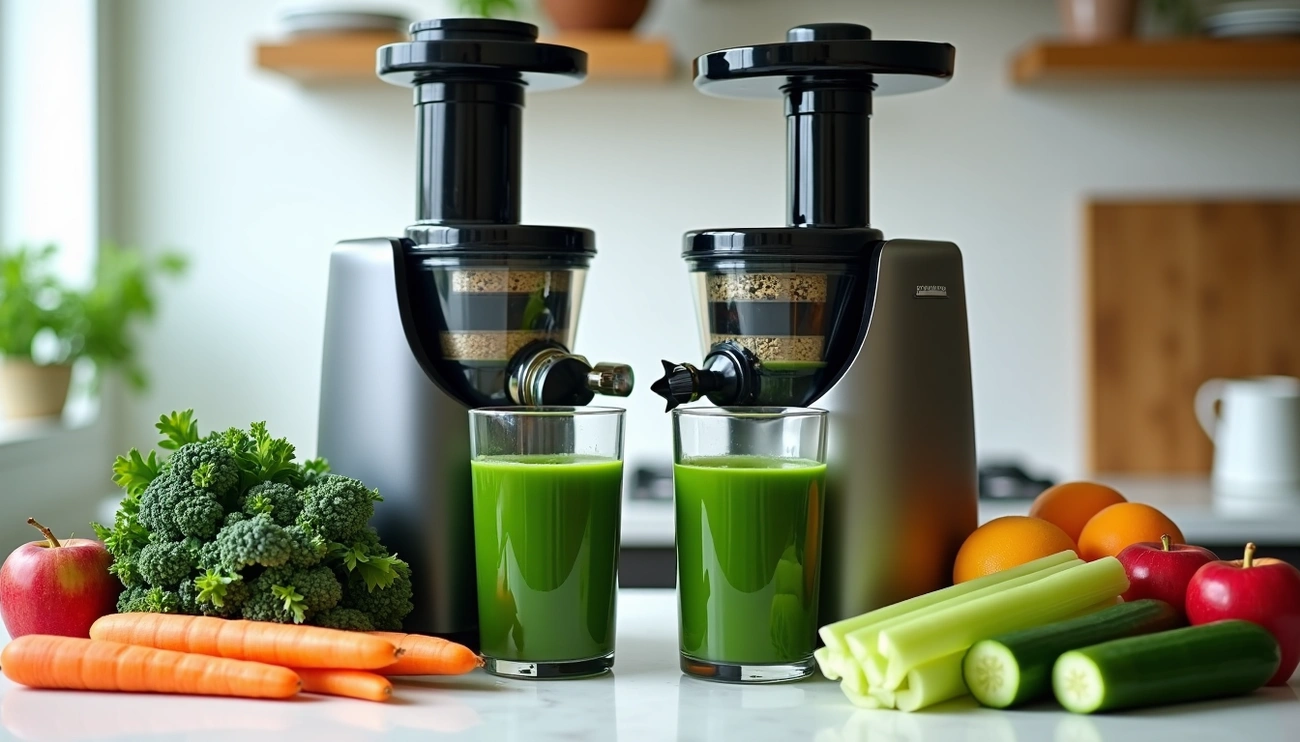
The main difference between Kuvings Juicer vs Nama is batch capacity and convenience focus. The Kuvings AUTO10 delivers faster, more powerful juicing with a 3-liter hopper and a 15-year warranty, making it ideal for large daily batches. The Nama J2 prioritizes simplicity, easier cleanup, and produces slightly drier pulp.
Quick Comparison: Nama vs Kuvings Juicer
Let’s dive into what makes these two juicer giants stand out from each other. Both Nama and Kuvings have carved unique niches in the premium juicer market, yet they differ in several key areas that could influence your buying decision.
Brand background and reputation
Kuvings and Nama represent different philosophies in the juicing world. Nama focuses on clean design, ease of use, and hands-free functionality—making cold-pressed juice more approachable for beginners. Their approach prioritizes simplicity without sacrificing performance.
Kuvings, on the other hand, has established itself through years in the industry. The brand caters to users seeking power, size, and versatility with extras like smoothie and sorbet attachments. For those juicing frequently or in large batches, Kuvings has built its reputation on meeting these needs.
What’s fascinating about Nama is its manufacturing connection—the juicers are produced in Hurom’s South Korean facilities. Hurom itself is considered a pioneer in the cold-press juicing industry, which adds credibility to Nama’s engineering despite being the newer brand in the spotlight.
Cold press technology used
At their core, both manufacturers rely on masticating (cold press) technology that preserves nutrients, reduces oxidation, and creates smoother juice with minimal foam. This slow-squeeze approach differs dramatically from centrifugal juicers that spin at high speeds.
The two brands share several technological similarities:
- Vertical design configuration for smaller countertop footprint
- Self-feeding hoppers designed to reduce prep time
- Focus on nutrient preservation through slow crushing
Nevertheless, there are performance differences worth noting. Nama typically performs better with leafy greens, a notorious challenge for many juicers. Meanwhile, Kuvings generally excels with batch size capabilities and includes additional features that expand its functionality beyond basic juicing.
Price and warranty overview
The price differential between these brands is significant. The Nama J2 retails for approximately $550-$599, positioning it as the more budget-friendly option, particularly for beginners. In contrast, the original Kuvings AUTO10 comes in at $699, with the advanced AUTO10 Plus commanding the highest price at $739.
Regarding materials, both use food-grade, BPA-free plastics. Nama emphasizes premium plastics with stainless steel components, while Kuvings utilizes specialized Tritan and Ultem materials. The AUTO10 Plus specifically features a stainless steel cutting blade for enhanced durability.
When it comes to warranty protection, there appears to be some inconsistency in reports. Most reliable sources indicate that Nama provides a generous 15-year warranty on both motor and parts[21], demonstrating remarkable confidence in their product’s longevity. Kuvings typically offers a 10-year warranty[21], which, although shorter than Nama’s, still represents substantial coverage for a kitchen appliance.
The warranty difference, combined with the lower entry price, suggests Nama may offer better long-term value—though Kuvings counters with more included attachments and features that might justify its premium pricing for certain users.
Nama J2 Juicer: Features and Performance
The Nama J2 represents a significant shift in how modern juicers operate. Unlike traditional models requiring constant feeding, this innovative machine offers a truly hands-free experience that changes the juicing process entirely.
Hands-free operation and design
At the heart of the Nama J2’s appeal is its revolutionary self-feeding hopper system. This large pitcher-like container allows you to add all ingredients simultaneously rather than feeding them piece by piece. Once loaded, the processing blade automatically trims down larger pieces and funnels them into the auger. This design innovation means you can set it and walk away to handle other kitchen tasks.
The J2 streamlines preparation time substantially since you no longer need to cut produce into tiny pieces. Whole fruits and vegetables can be added with minimal trimming. This reduction in prep work makes daily juicing much more practical and less of a time-consuming chore.
Juice quality and pulp dryness
Regarding extraction efficiency, the Nama J2 delivers impressive results. The juicer yields up to 60% more juice from the same amount of ingredients compared to traditional high-speed juicers. This efficiency comes from its slow-pressing technique that thoroughly extracts liquid from produce.
The pulp output tells the true story of any juicer’s effectiveness. With the Nama J2, pulp emerges remarkably dry and crumbly – a clear indicator of thorough extraction. In testing, the machine produced 460ml of juice from just four oranges, showcasing its ability to maximize yield from minimal produce.
Juice quality isn’t just about quantity, furthermore, it’s about nutrient preservation. The J2’s slow 50 RPM speed minimizes oxidation and heat generation, maintaining the natural flavor profile and nutritional integrity of your ingredients.
Ease of use and cleaning
Assembly of the Nama J2 takes approximately two minutes or less, with parts that connect intuitively. The straightforward design makes daily use accessible even for juicing beginners.
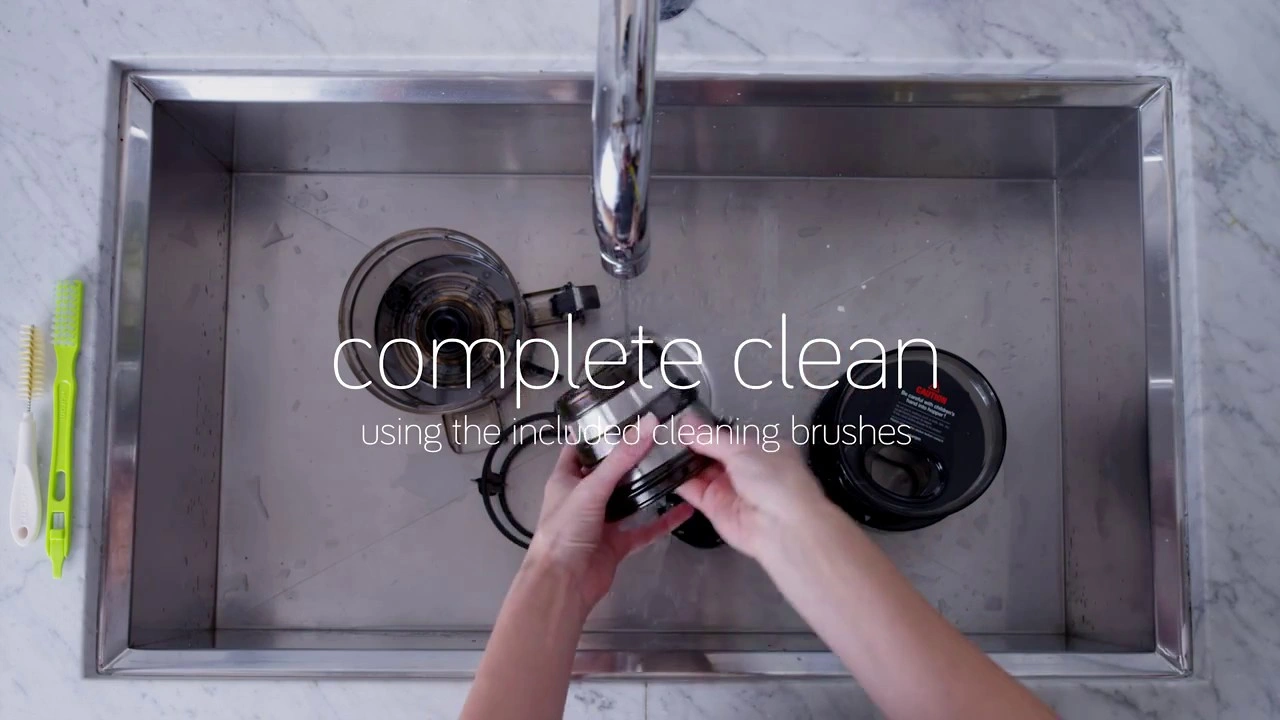
Cleaning – typically the most dreaded aspect of juicing – has been thoughtfully addressed. The juicer disassembles easily, and most components can be rinsed clean with minimal effort. A specialized cleaning brush resembling a large toothbrush comes included to help clear stubborn debris. The entire cleaning process typically takes less than five minutes – significantly faster than many competing models.
For deeper cleaning, Nama recommends soaking parts overnight in a mixture of warm water and baking soda. The pulp outlet gasket can be easily removed and cleaned, then pushed back into place.
Noise level and build quality
Remarkably quiet operation sets the Nama J2 apart from louder centrifugal models. It produces a gentle hum comparable to a desk fan on low setting or approximately 62 decibels – no louder than a dishwasher or normal conversation. This quiet operation makes early morning juicing possible without disturbing household members.
Build quality is solid and substantial, reflecting its premium positioning. Manufactured in South Korea by a company with over 40 years of industry experience, the J2 features a stainless steel strainer containing 6,612 micro-perforations that facilitate the slow squeezing process.
Limitations to consider
Despite its impressive features, the Nama J2 has limitations worth acknowledging. The most obvious is its price point – retailing between $550-$599, it represents a significant investment. Additionally, its footprint requires adequate counter or storage space.
The machine isn’t dishwasher safe, necessitating hand washing after each use. When juicing stringy produce or processing large batches, occasional pausing to clean the auger might be necessary.
For those making plant-based milks, results are good but not perfect – the almond milk produced is fresh but somewhat grainier than store-bought alternatives.
The Nama J2’s balance of performance, ease of use, and reliability makes it a strong contender against Kuvings models, albeit with different strengths and limitations that might influence which machine better suits your specific juicing needs.
Kuvings Auto10 and Auto10 Plus: What You Get
Kuvings raises the bar with its Auto10 and Auto10 Plus models, offering impressive batch processing capabilities that cater to serious juicing enthusiasts and busy families alike.
Hopper size and batch capacity
The Auto10 features a generous 100oz capacity hopper—the largest on the market—enabling users to pre-load whole ingredients with minimal prep cutting. This substantial size eliminates the need to feed ingredients one at a time, transforming the batch juicing experience. For those requiring even more capacity, the Auto10 Plus steps things up with its remarkable 135oz hopper, making it ideal for large-volume juicing sessions. Both models allow you to simply load ingredients, start the machine, and attend to other tasks while your juice is being prepared.
Motor power and runtime
Central to both juicers’ performance is a robust 240W heavy-duty induction motor that operates at approximately 50 RPM. What truly sets these models apart is their continuous runtime capability—up to 45 minutes without overheating. Indeed, some users report successful juicing sessions approaching an hour without any shutdowns. The motors are engineered for quietness as well, with a low-noise design that reduces both sound and vibration.
Attachments included
Several thoughtful accessories accompany these machines. Each Kuvings juicer comes with specialized cleaning tools including a cleaning brush and round brush. Moreover, the Auto10 Plus includes a sorbet attachment that produces excellent texture—so impressive that some users report it might replace dedicated ice cream makers. Additional functionalities include the ability to make smoothies and nut milks beyond standard juicing.
Performance with tough produce
During testing, the Kuvings Auto10 handled most produce efficiently, particularly excelling with peeled oranges and turmeric roots. The yield remains consistently high across various juice types. Nevertheless, fibrous vegetables like celery and leafy greens can occasionally present challenges. Some users recommend pre-cutting longer celery stalks to prevent potential clogging in the pulp chute.
Footprint and storage concerns
At approximately 10 x 8 x 18 inches and weighing 16.5 pounds, the Auto10 has a substantial presence. The Auto10 Plus stands even taller at 20 inches. Despite having a relatively reasonable countertop footprint, its height means it may not fit under standard kitchen cabinets. Storage presents another consideration—not only for the main unit but also for its numerous parts, some of which nest together while others don’t. Subsequently, adequate cabinet space becomes essential unless you plan to keep it permanently on your counter.
Nama vs Kuvings Juicer: Head-to-Head Comparison
After testing both brands extensively, I’ve found that putting Kuvings juicer vs Nama head-to-head reveals surprising strengths and weaknesses. Let’s examine how these premium juicers truly perform against each other.
Juice yield and pulp output
In direct yield comparisons, the difference between these machines is remarkably small—less than 4% spread across different produce types. Essentially, both deliver excellent extraction, yet with different specialties. The Nama J2 excels with leafy greens, producing consistently drier pulp, while Kuvings performs better with hard vegetables.
For overall value, Nama edges ahead with a 9/10 rating for yield compared to Kuvings’ 8/10, primarily because its pulp emerges noticeably drier in most tests.
Performance with leafy greens and soft fruits
The Nama J2 truly distinguishes itself with leafy greens, delivering excellent results where many juicers struggle. First of all, it handles kale and spinach efficiently, especially when combined with cucumber or celery.
Kuvings shows particular strength with soft fruits and balanced loads but can occasionally clog if overloaded. Its batch processing capability makes it ideal for large families needing substantial juice quantities.
Setup and cleanup time
Setup times differ significantly—Nama offers simpler assembly with fewer steps to get started. As a result, daily use becomes more convenient for those who juice frequently.
For cleanup, Nama’s pulp chute unlocks into two pieces, making it substantially easier to clean without special tools. Kuvings requires more thorough cleaning with multiple parts and crevices to address.
Noise levels and durability
Noise levels show clear differences: Kuvings registers at 70-72 decibels for the original AUTO10, while both the AUTO10 Plus and Nama J2 operate at a quieter 65-66 decibels—comparable to a dishwasher.
Regarding durability, Kuvings incorporates more substantial materials including the stainless steel cutting blade in the AUTO10 Plus. Nama uses high-quality BPA-free plastic components that require somewhat more careful handling.
Versatility and extra features
To conclude this comparison, both machines include juicing screens and smoothie strainers for different textures. Kuvings provides a sorbet attachment standard with both the AUTO10 and AUTO10 Plus, while Nama sells this as an optional upgrade. Both manufacturers offer separate citrus attachments for handling large citrus batches.
Which Juicer Fits Your Lifestyle Best?
Now that we’ve compared the features, let’s consider how these juicers fit different lifestyles and household needs. First and foremost, your kitchen space, family size, and personal values should guide your final decision.
Best for small kitchens and daily use
The Nama J2 clearly wins for compact spaces with its smaller footprint and lighter weight. At just 17 inches tall, it fits under most kitchen cabinets, making it ideal for apartments or kitchens with limited counter space. In particular, the J3 model offers an even more compact design with a 34 oz hopper, perfect for those preparing single servings. Its straightforward assembly and quick cleanup process further enhance its suitability for daily juicing routines.
Best for batch juicing and large families
For households needing substantial juice quantities, Kuvings AUTO10 Plus stands unmatched. Its massive 135 oz hopper capacity allows preparing juice for several days at once. The extended runtime capability—up to 45 minutes without overheating—makes it suitable for families who batch-prepare juice weekly. As such, the Kuvings excels when volume is your primary concern.
Sustainability and packaging differences
Nama demonstrates superior environmental consciousness through completely compostable and recyclable packaging. Instead of styrofoam, they use bamboo handles, reusable bags, and plant-based dyes. In turn, Kuvings relies on recyclable cardboard exteriors but still packages parts in styrofoam and plastic.
Beginner-friendly vs power-user models
For novices entering the juicing world, Nama offers a more approachable experience with simpler cleaning and quieter operation. The Kuvings system, requiring more learning but delivering bigger batches, better serves experienced users who prioritize maximum capacity. Beyond that, Nama’s exceptional 15-year warranty on all components provides beginners with lasting peace of mind.
Conclusion
Choosing between Kuvings and Nama ultimately comes down to your specific juicing needs and lifestyle. Both brands offer exceptional cold-press technology that preserves nutrients while delivering high-quality juice. However, they excel in different areas that might sway your decision.
The Nama J2 stands out with its user-friendly design, simplified cleaning process, and impressive performance with leafy greens. Additionally, its 15-year warranty provides remarkable peace of mind for a significant investment. First-time juicers will appreciate its straightforward operation and quieter performance.
Kuvings AUTO10 and AUTO10 Plus, though pricier, deliver unmatched batch processing capabilities. Their massive hoppers and extended runtime make them ideal for families or weekly meal preppers. The included attachments for sorbet and smoothies certainly add value for those seeking versatility.