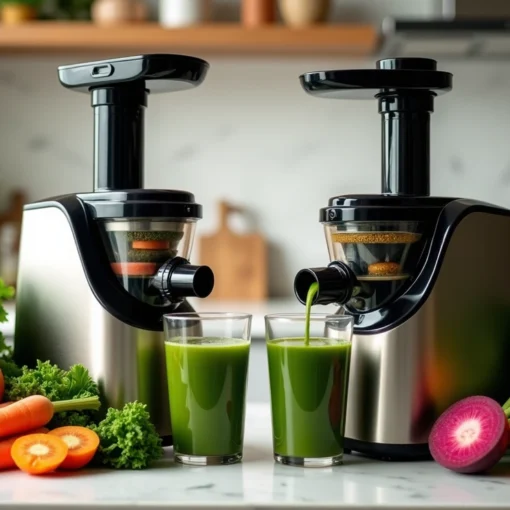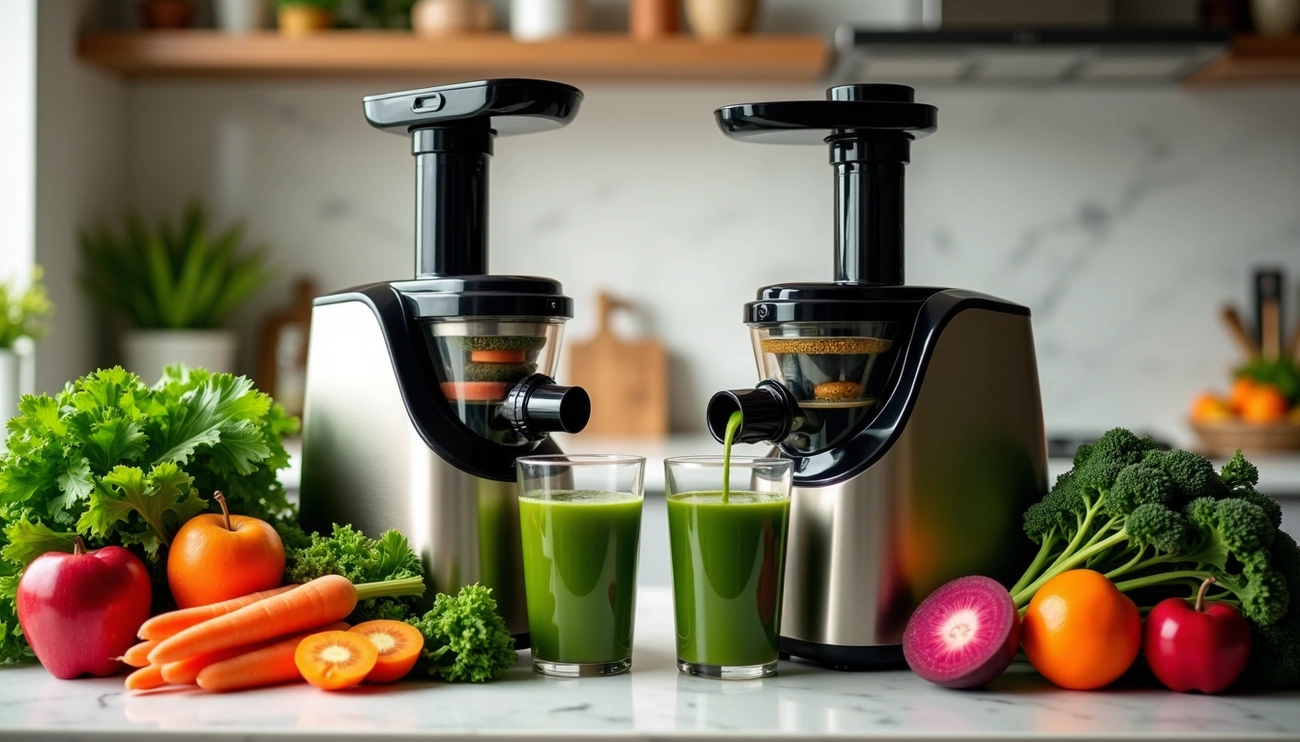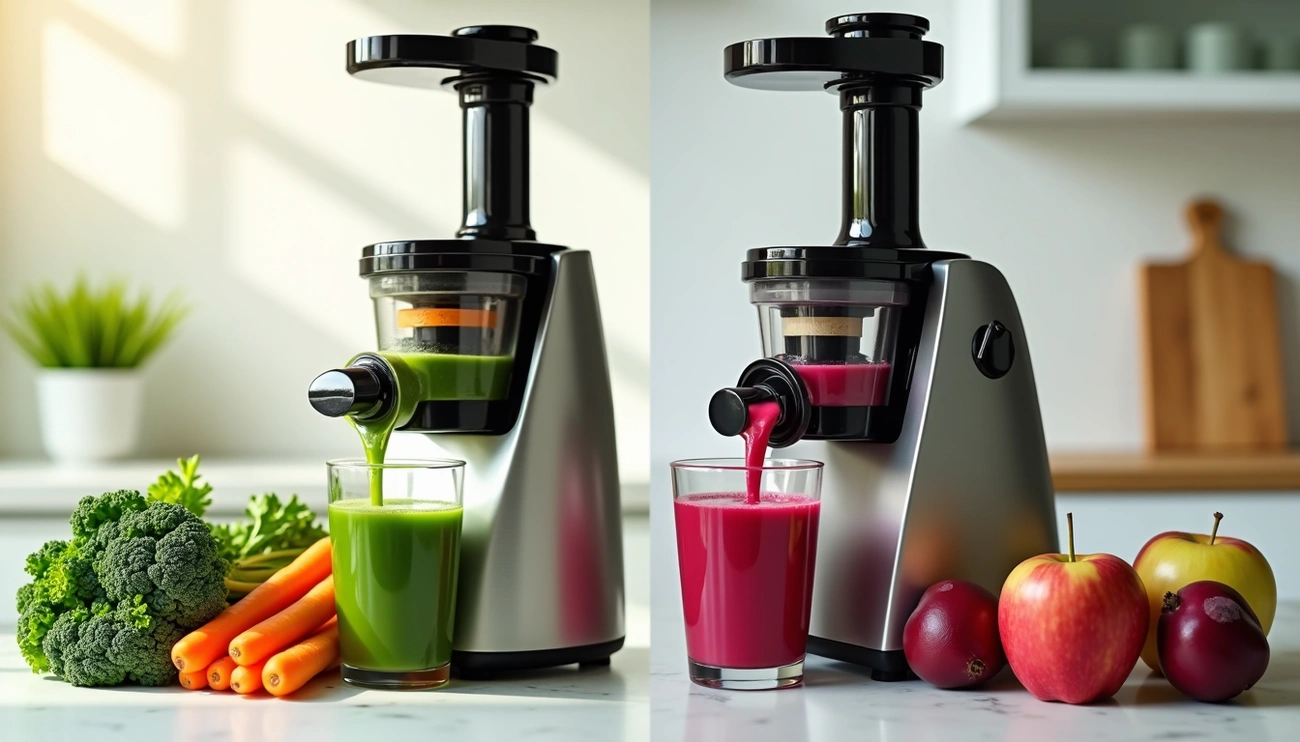
The main difference between centrifugal or masticating juicer is speed versus juice quality. Masticating juicers operate at 40–100 RPM, maximize nutrient retention, and produce higher yields, especially for leafy greens. Centrifugal juicers spin at 6,000–14,000 RPM, juice faster, and cost less. Choose masticating for daily, high-quality juicing and centrifugal for speed and convenience.
What is a Masticating Juicer?
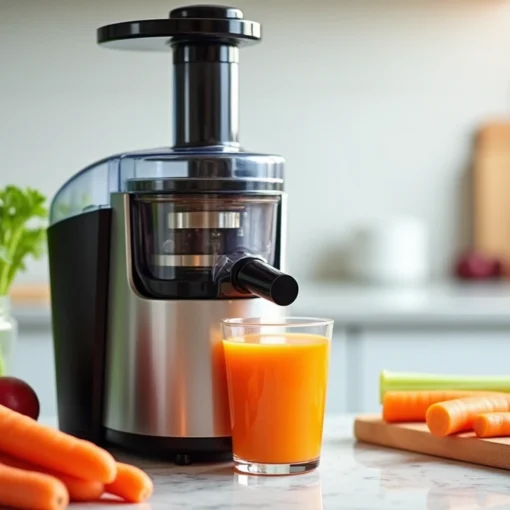
Masticating juicers operate on a fundamentally different principle than their centrifugal counterparts. These devices, sometimes called “slow juicers” or “cold press juicers,” extract juice through a gentle, methodical process that preserves more nutrients from your produce.
How it works: slow pressing with an auger
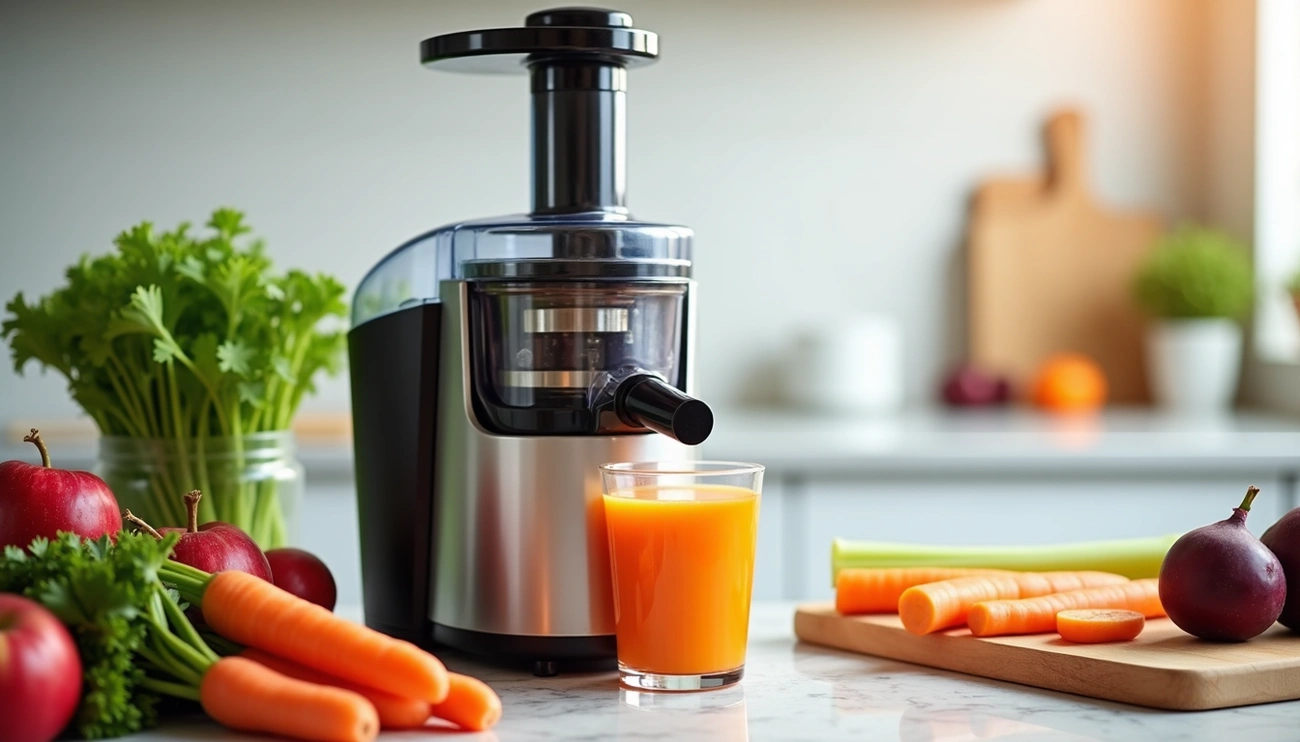
At the heart of a masticating juicer is a component called an auger – a drill or screw-like mechanism that rotates slowly to crush fruits and vegetables against a fine screen. Unlike centrifugal models that spin at 3,000-16,000 RPM, masticating juicers operate at just 80-100 RPM. This deliberate pace allows the juicer to thoroughly crush produce into a pulp, which is then pressed to extract the maximum amount of juice.
The process begins when fruits and vegetables are fed through a chute. The rotating auger then grinds them into a fine pulp, breaking down cell walls to release deep-seated nutrients. This pulp is pushed against a mesh filter or screen with thousands of micro-perforations (some models feature up to 6,612 tiny holes), separating the juice from the fibrous material.
Benefits of cold press extraction
The slow extraction method of masticating juicers offers several significant advantages. First, they generate minimal heat and oxidation during the juicing process, preserving enzymes, vitamins, and minerals in their natural state. This results in higher-quality juice that maintains its nutritional integrity.
Furthermore, masticating juicers extract substantially more juice from the same amount of produce. Some models yield up to 30% more juice than other types, making them more economical over time despite their higher initial cost.
Additionally, cold-pressed juice typically contains less foam and experiences less separation, maintaining its freshness longer – up to 2-3 days in some cases.
Best for leafy greens and soft fruits
Perhaps the most notable advantage of masticating juicers is their exceptional performance with leafy greens. Unlike centrifugal models that struggle with fibrous materials, masticating juicers excel at extracting juice from kale, spinach, wheatgrass, and other leafy vegetables.
Beyond greens, these versatile machines can process virtually any produce – from soft fruits to root vegetables – with impressive efficiency. Their slow, thorough extraction means you’ll get more juice and nutrients from everything you process, particularly from delicate ingredients that might yield little in a high-speed juicer.
What is a Centrifugal Juicer?
Centrifugal juicers dominate the market as one of the most popular and accessible options for home juicing enthusiasts. If you’ve ever seen a juicer with a rapidly spinning interior and heard a powerful motor whirring away, you’ve encountered a centrifugal model. Let’s explore how these common appliances work and whether they might be right for your needs.
How it works: high-speed spinning blade
The mechanics of a centrifugal juicer are straightforward yet effective. These machines utilize a fast-spinning metal blade positioned against a mesh filter to extract juice through centrifugal force. Essentially, when you feed produce through the chute, it encounters a blade spinning at remarkable speeds—some models reaching up to 10,000 RPMs. This high-velocity cutting action shreds fruits and vegetables into tiny pieces, then flings them against the surrounding mesh filter basket.
The centrifugal force pushes the juice through the mesh while separating the pulp, which gets collected in a side container. This entire process happens remarkably quickly, often producing juice in just seconds. Most centrifugal juicers include these key components:
- A base housing the spinning motor
- A mesh filter tray with blades
- A pulp container for waste collection
- A lid with food pusher
- A chute for feeding produce
Ideal for hard fruits and quick juicing
Centrifugal juicers truly excel with harder, denser produce. Their powerful motors and high-speed operation make quick work of:
Apples, beets, cabbage, carrots, celery, cranberries, fennel, ginger root, pears, pomegranates, and sweet potatoes. The wide feed chutes found on most centrifugal models can accommodate larger pieces or even whole fruits, significantly reducing preparation time. Moreover, for busy individuals, the speed advantage is considerable—juice appears almost instantly after feeding produce into the machine.
Common drawbacks: heat and oxidation
Nevertheless, the high-speed operation that makes centrifugal juicers so convenient creates some notable downsides. The rapid spinning generates friction, which produces heat that can potentially degrade certain nutrients and enzymes. This heating effect becomes more pronounced with extended juicing sessions.
Additionally, the high-speed spinning process introduces significant amounts of air into the juice. This accelerates oxidation, causing the juice to darken faster, separate more quickly, and lose its fresh taste more rapidly than juice from slower extraction methods. You’ll likely notice more foam in centrifugally-extracted juice, and the juice generally has a shorter shelf life.
Finally, centrifugal juicers typically struggle with leafy greens and softer fruits, which require more steady pressure rather than cutting force to properly extract juice.
Masticating vs Centrifugal Juicer: Key Differences
Now that we understand each juicer type, let’s examine their head-to-head differences to determine which is better: centrifugal or masticating juicer.
Juice quality and nutrient retention
The difference between centrifugal and masticating juicer output is substantial. Scientific studies reveal masticating juicers retain 82% of vitamin C after 24 hours compared to 67% with centrifugal models. Similarly, masticating juicers preserve 94% of antioxidants versus 78% with centrifugal methods, and maintain 89% enzyme activity after 6 hours compared to just 54% with high-speed juicing. This occurs because centrifugal juicers’ high-speed blades generate heat and introduce air, accelerating oxidation.
Speed and efficiency
Centrifugal juicers operate at 6,000-14,000 RPM, processing juice in 1-2 minutes per serving. In contrast, masticating juicers run at a modest 80-120 RPM, taking 4-6 minutes per serving. However, masticating models extract substantially more juice—particularly from leafy greens (72% yield vs 45%) and wheatgrass (85% yield vs 15%).
Noise levels and user experience
Masticating juicers operate at 45-55 decibels (comparable to conversation), whereas centrifugal models produce 75-85 decibels (similar to city traffic). This 20-30 decibel difference makes masticating juicers approximately 4-8 times quieter.
Cleaning and maintenance
Centrifugal juicers typically require 3-5 minutes for daily cleaning, while masticating models need 5-7 minutes. Longevity also differs markedly—masticating juicers last 8-15 years versus 3-7 years for centrifugal types.
Cost and long-term value
Although masticating juicers cost more initially ($200-$400 entry-level vs $50-$150 for centrifugal), five-year analysis shows masticating juicers actually save approximately $2,100 through higher yields and less frequent replacements.
Which Juicer is Right for You?
Selecting the perfect juicer depends entirely on your specific needs, lifestyle, and juicing goals. Let me help you navigate these choices based on what matters most to you.
For health-focused users
If maximum nutrition is your priority, masticating juicers are your best option. Their slow extraction process minimizes oxidation and heat, preserving more enzymes, vitamins and minerals in their natural state. These cold press machines extract up to 30% more juice from produce, resulting in higher quality beverages that maintain their nutritional integrity. Specifically for health enthusiasts, masticating juicers excel with leafy greens and wheatgrass—ingredients that deliver concentrated nutrients but challenge centrifugal models.
For busy lifestyles
Short on time? Centrifugal juicers deliver nearly instant results with minimal prep work. Their wide feed chutes (often 3 inches) accommodate larger pieces or even whole fruits, significantly reducing preparation time. Many modern centrifugal models feature dishwasher-safe components for quick cleanup. For truly time-pressed individuals, certain premium models like the Kuvings AUTO10 Plus offer hands-free operation—simply load the hopper and walk away.
For budget-conscious buyers
Centrifugal juicers typically range from $50-$300, making them more accessible entry points. Masticating models start around $200-$750, representing a substantial investment. Accordingly, consider long-term value—masticating juicers last 8-15 years versus 3-7 years for centrifugal types. In fact, some premium models offer warranties up to 15 years, protecting your investment.
For beginners vs experienced juicers
Newcomers often appreciate centrifugal models’ simplicity, intuitive operation, and lower price points. First-time juicers should consider machines with straightforward controls, minimal assembly requirements, and easy-to-clean designs. Experienced users typically value masticating juicers’ versatility, consistency, and superior performance with challenging ingredients. Of course, your commitment level matters—casual juicers might prefer convenient centrifugal models while dedicated enthusiasts will appreciate masticating juicers’ superior results.
Conclusion
Choosing between centrifugal and masticating juicers ultimately depends on your priorities and lifestyle. Though masticating juicers cost more upfront, they extract significantly more juice, preserve more nutrients, operate quietly, and last nearly twice as long as centrifugal models. Health enthusiasts will undoubtedly benefit from their superior ability to process leafy greens and maintain enzymatic activity.
Conversely, centrifugal juicers shine with their speed, simplicity, and lower initial investment. Busy individuals who mainly juice harder fruits and vegetables will appreciate the quick results and easier cleanup these models offer.
Before making your decision, consider what matters most to you. Will you juice daily or occasionally? Do you primarily want leafy green juices or fruit blends? How important is nutrient preservation versus convenience? Your answers will guide you toward the right choice.